Never Merge: Designing an Autonomous Agent You Can Actually Trust
The scariest sentence in AI tooling is four words long: "and then it commits."
Everything before those words can be impressive. The agent read the issue, understood the bug, navigated an unfamiliar codebase, wrote a clean fix, ran the tests. Genuinely remarkable. And then it commits to main, and every bit of that impressiveness curdles into risk, because now a system that is wrong a predictable fraction of the time has write access to the one branch you can't afford to be wrong about.
When I built an agent to fix bugs unattended overnight, the most important decision I made was not a capability. It was a refusal. The agent never merges, and it never closes your issues. It does all the work, and then it stops — deliberately, permanently, by design — one step short of the only action it can't take back.
This post is about why that refusal is the most important engineering in the whole system, and what it taught me about how trust in autonomous software actually gets built.
The complete project is open source: github.com/jeromeetienne/issue_autofix.
Trust is not a feeling you earn by being smart
There's a tempting and wrong model of how to make an autonomous agent trustworthy: make it better. Smarter model, sharper prompts, more context, higher accuracy. Get the error rate low enough and surely, eventually, you can let it merge.
This is a trap, and it's worth being precise about why.
The error rate of these systems is never zero. You can push it down, but you cannot push it to zero, and — this is the part that kills the "just make it smarter" plan — the errors that survive are the confident ones. The model isn't uncertain when it's wrong. It hands you a fix that looks right, reads right, and is wrong in a way that requires your judgment to catch. So "high accuracy" doesn't actually earn the right to skip review. It just makes the failures rarer, stranger, and better-disguised — which is to say, more dangerous, because rare confident errors are exactly the ones you stop watching for.
If you can't make the failures impossible, the entire question changes. It stops being "how do I trust the agent's output" and becomes "how do I arrange things so that a wrong output is cheap." You don't build trust by making the agent right. You build it by making the agent safe to be wrong. Those are completely different engineering problems, and only the second one is solvable.
Trust is built from boundaries
So you design the boundaries instead of chasing the accuracy. Three of them, in this system, and each one exists to make a mistake survivable rather than to make it impossible.
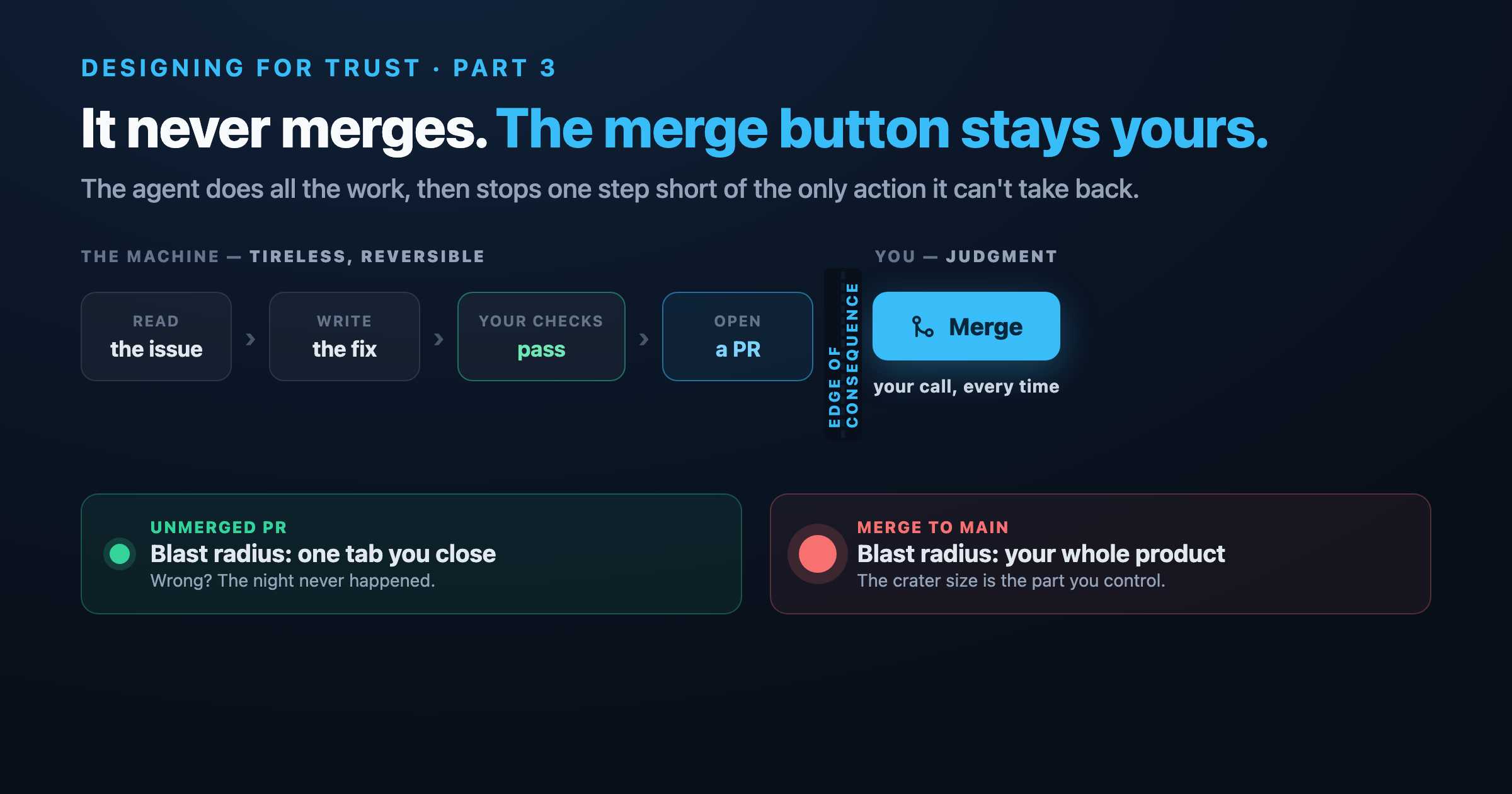
The agent only proposes. It stops at the pull request, every time. The single most consequential, least reversible action in the whole workflow — putting code into your main branch — is the one action the agent structurally cannot take. Everything it does is a proposal sitting in a pull request, which is the most reviewable, most revertible, most normal artifact in your existing workflow. There's no special "AI review" you have to learn. It's just a pull request, and you already know exactly what to do with one of those: read it, and decide.
It only ships what reality has approved. A pull request opens only if your project's own checks pass — not a generic notion of correctness, but your tests, your type-checker, your build, run in a real environment built for the purpose. The model's confidence in its own fix is worth nothing here; it's not the gate. The gate is whether the thing actually passed the bar your project already sets for human contributors. That's the difference between an agent that believes itself and one that has to earn its place against the same checks you'd hold a colleague to.
The human is the merge gate, and that's non-negotiable. Not a setting. Not a "you can disable this in config." The division of labor is the architecture: the machine produces candidates and proves they pass; you decide what becomes real. The agent's job ends exactly where consequence begins, and yours begins exactly there. Every autonomous action it takes is, by construction, reversible — close the pull request and it's as if the night never happened — because the one irreversible action was reserved for you.
None of these three is about making the agent smarter. Every one is about shrinking what a mistake can cost. That's the move. That's the whole philosophy in one line: you don't make the agent trustworthy, you make its mistakes cheap.
Blast radius is the real design variable
Here's the mental model I kept coming back to, and the one I'd hand to anyone designing autonomous software: stop optimizing the probability of error and start optimizing the cost of error. The thing you are actually designing is the blast radius.
A merge to main is a blast radius the size of your whole product. An unmerged pull request is a blast radius the size of one tab you close. Same wrong fix, same model, same error — the only thing that changed is the size of the crater, and the size of the crater is the part you control. That's the entire game. You will never win the fight to make the agent never wrong. You can completely win the fight to make "wrong" not matter.
Notice what this buys you, because it's almost paradoxical: the constraint is what enables the autonomy. The reason you can label twenty issues and walk away — the reason the overnight, unattended, hands-off part is safe at all — is precisely that the agent can't merge. Take the constraint away, let it merge "when it's confident," and you could no longer leave it alone. You'd have to supervise it, because the cost of an unsupervised mistake just went from a closed tab to a production incident. The leash is what lets the dog off the leash. Remove the boundary in the name of more autonomy and you get less, because now someone has to watch.
This is the counterintuitive heart of it. People think safety and autonomy trade off against each other — that a safer agent is a more limited one. It's the reverse. The boundary is the thing that makes the freedom usable. Confidence comes from constraint.
What this says about where we're going
It's fashionable to frame agentic coding as a march toward removing the human — each release a little more autonomous, the human a little more vestigial, until one day the loop closes and we're not needed. I think that framing is wrong, and this project is a small argument for why.
The future this points at isn't "no humans." It's humans doing a different job. The tireless, repetitive, low-judgment work — producing the candidate fix, setting up the environment, running the checks, proving the thing holds — moves to the machine, where it belongs, because the machine is genuinely better at being tireless than you are. And the work that's actually yours — judgment, taste, deciding whether this is the right fix and whether it should exist at all — stays with you, sharpened, because now it's all you're doing. You stop typing the boring fixes and start reviewing them. You move up the stack from author to editor.
That's not a diminished role. For the small, well-scoped bugs this system handles, it's a strictly better one: you keep all the judgment and shed all the drudgery. And the design job — the actual skill in building these systems — is drawing that line in exactly the right place. Too far one way and you've built a toy that asks permission for everything and saves you nothing. Too far the other and you've built something that commits to main and demands the supervision it was supposed to spare you. The art is in the placement.
The measure of a good autonomous system, I've come to think, isn't how much it can do without you. Plenty of systems can do plenty without you; that's not hard and it's not the point. The measure is how cleanly it hands control back — how reliably it stops at the edge of consequence and says, here, this part is yours.
The agent never merges. That's not the feature I forgot to build. It's the one I built the whole system around.