Blog
Never Merge: Designing an Autonomous Agent You Can Actually Trust
by
Jerome Etienne
on
Mon Jul 06 2026
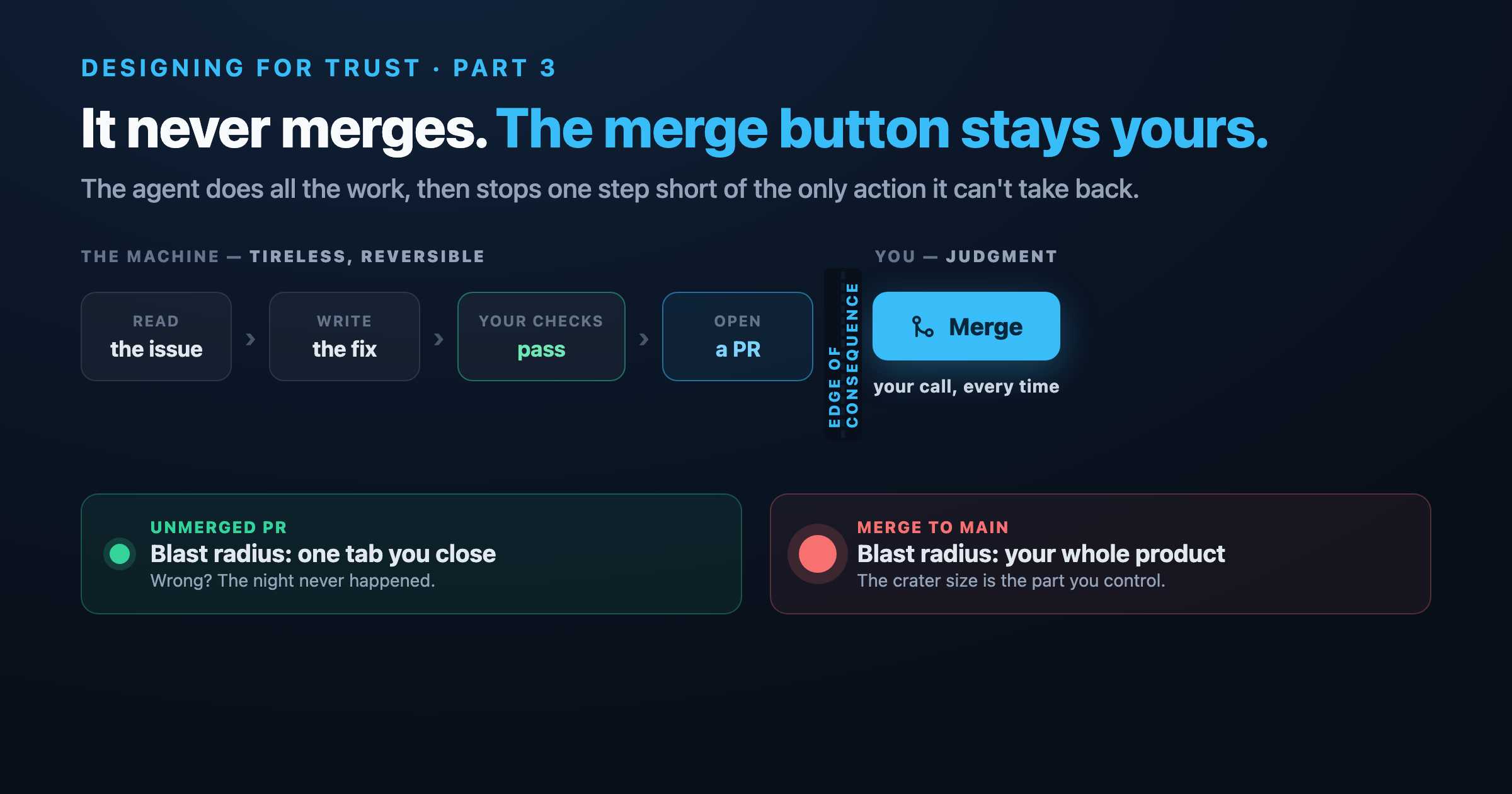
The scariest sentence in AI tooling is "and then it commits to main." When you build an agent that fixes bugs unattended overnight, the most important decision isn't a capability - it's a refusal. Why making mistakes cheap beats making the agent smart, and how trust in autonomous software actually gets built.
The Engineering Behind an Agent You Can Leave Running Overnight
by
Jerome Etienne
on
Wed Jul 01 2026
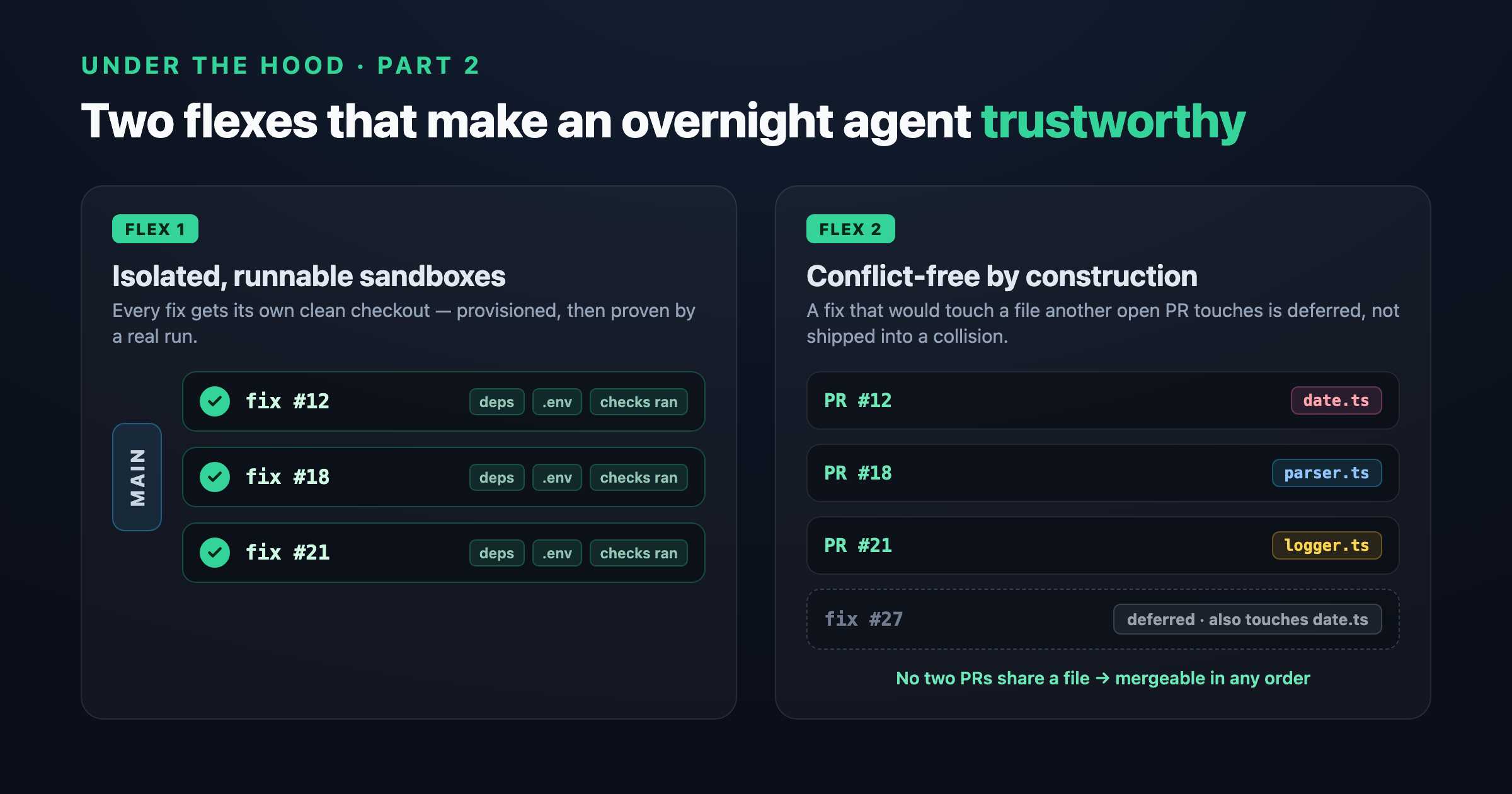
A one-shot "fix this bug" agent is a party trick. A system you can label twenty issues against and walk away from is engineering. Two pieces of craft close that gap - isolated, runnable sandboxes that make every fix prove itself, and conflict-free pull requests that merge in any order. The intelligence is rented; the trust is built.
Wake Up to Your Easy Bugs Already Fixed
by
Jerome Etienne
on
Fri Jun 26 2026
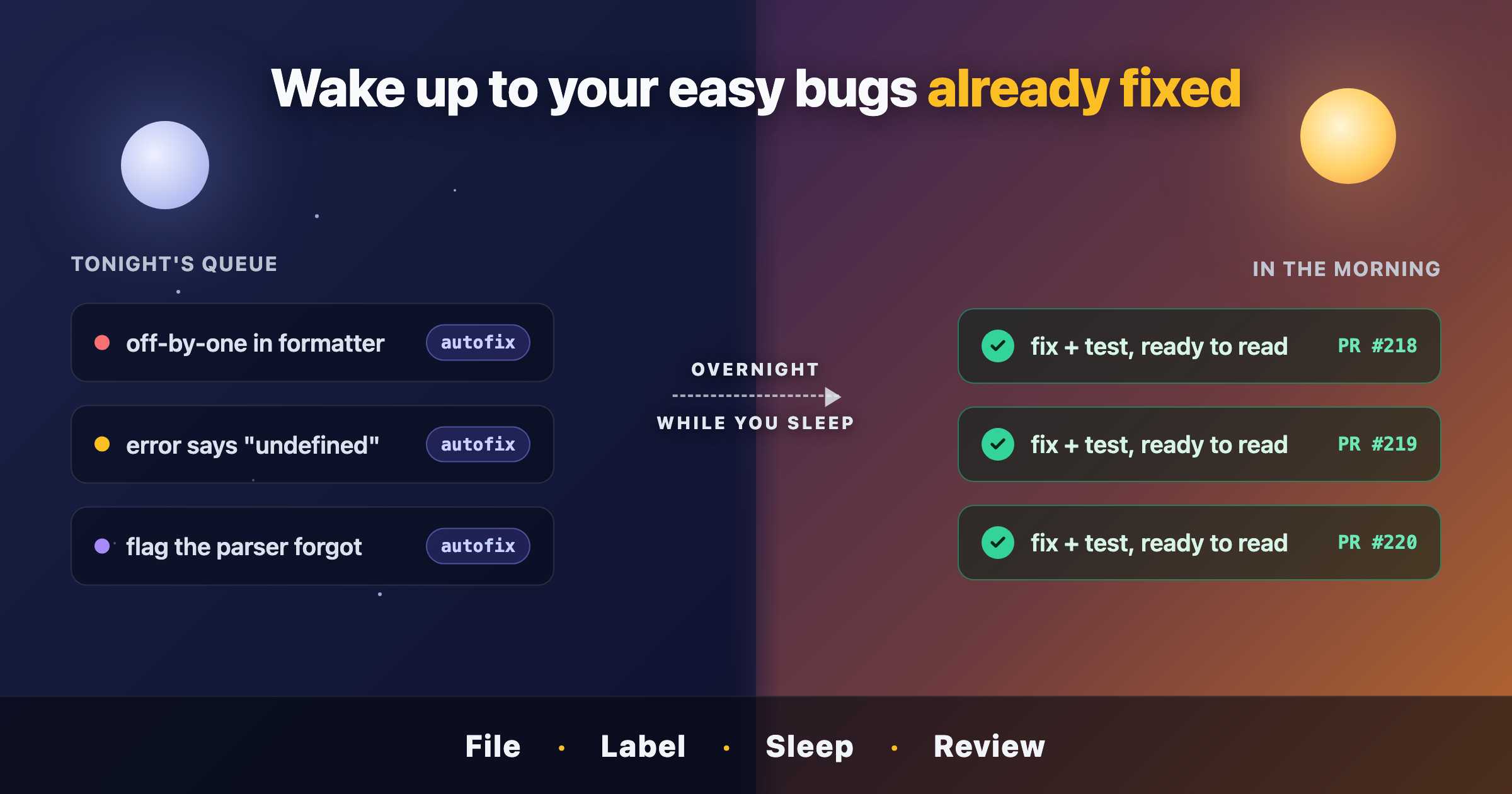
Label your easy bugs at the end of the day, go home, and wake up to a pull request waiting for each one - written, tested, and ready to review over coffee. The pitch for an overnight bug-fixing agent, and the one design decision that makes it something you'd actually trust.
Fine-Tuning Foundation Models - When Transfer Learning Works
by
Jerome Etienne
on
Wed Jun 17 2026
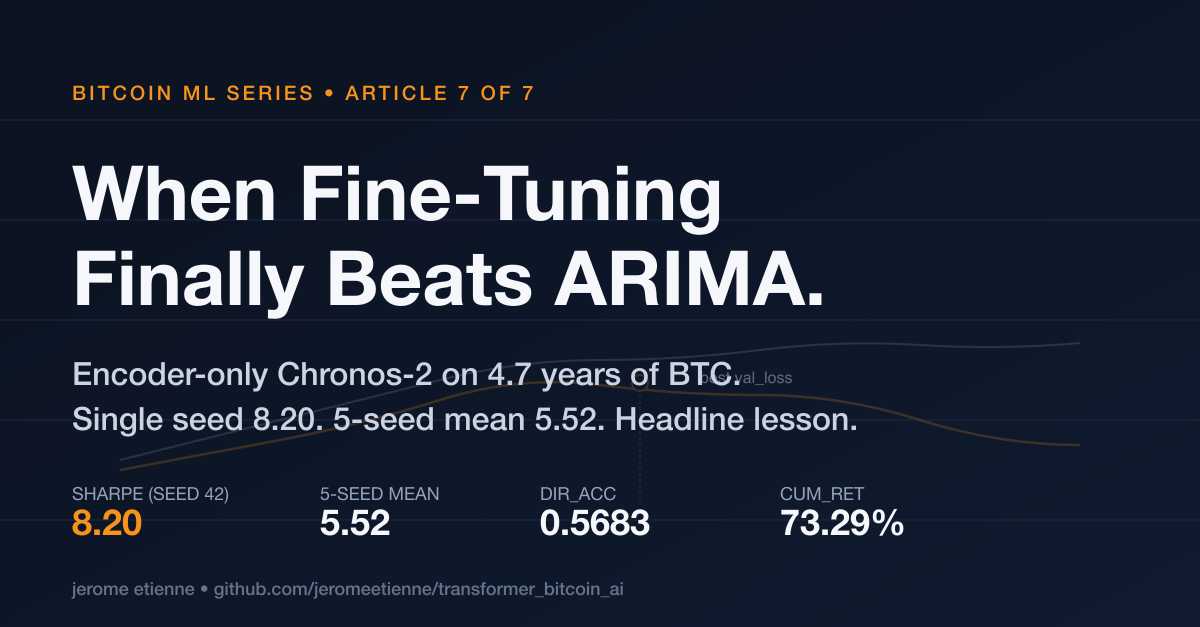
Encoder-only fine-tuning of Chronos-2-small on 4.7 years of Bitcoin history, with proper checkpoint restoration, finally produces a deep-learning win - but only under all three conditions, and only when read through a 5-seed confidence interval rather than a lucky single seed. The honest bottom line and what it costs to get there.
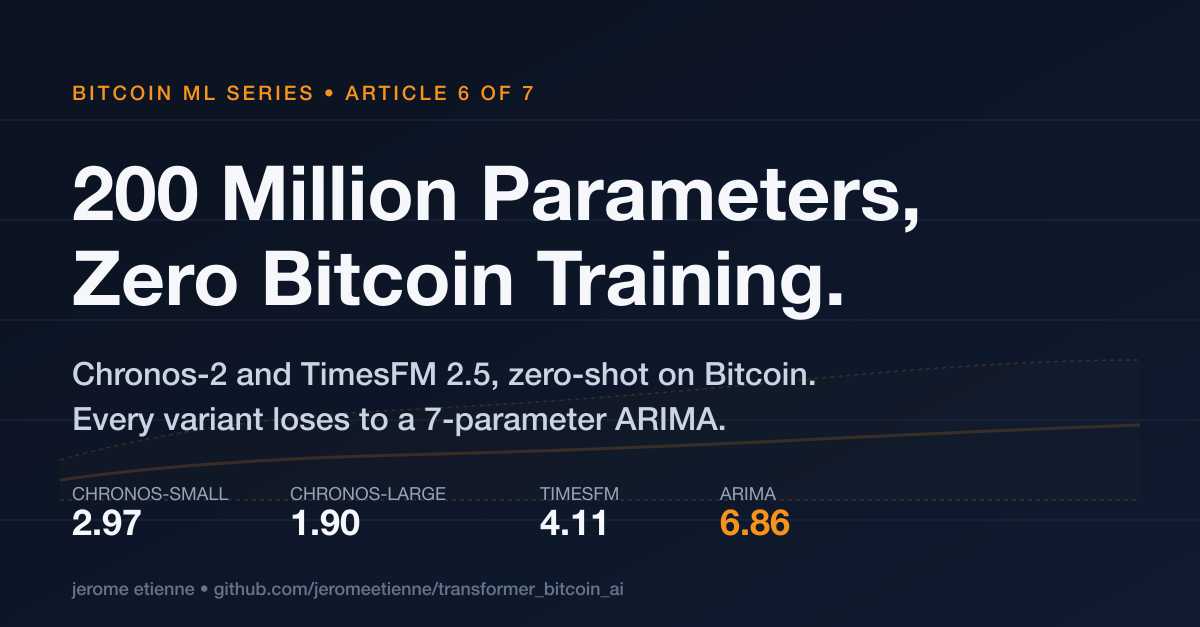
When a Model Trained on Everything Fails on Bitcoin
by
Jerome Etienne
on
Mon Jun 15 2026
Zero-shot Chronos-2 (28M/120M) and TimesFM 2.5 (200M) on Bitcoin without a single weight update. The pretrained prior - built on hundreds of millions of time series from every domain - loses to a 7-parameter ARIMA on every metric. A concrete look at where transfer learning quietly breaks.
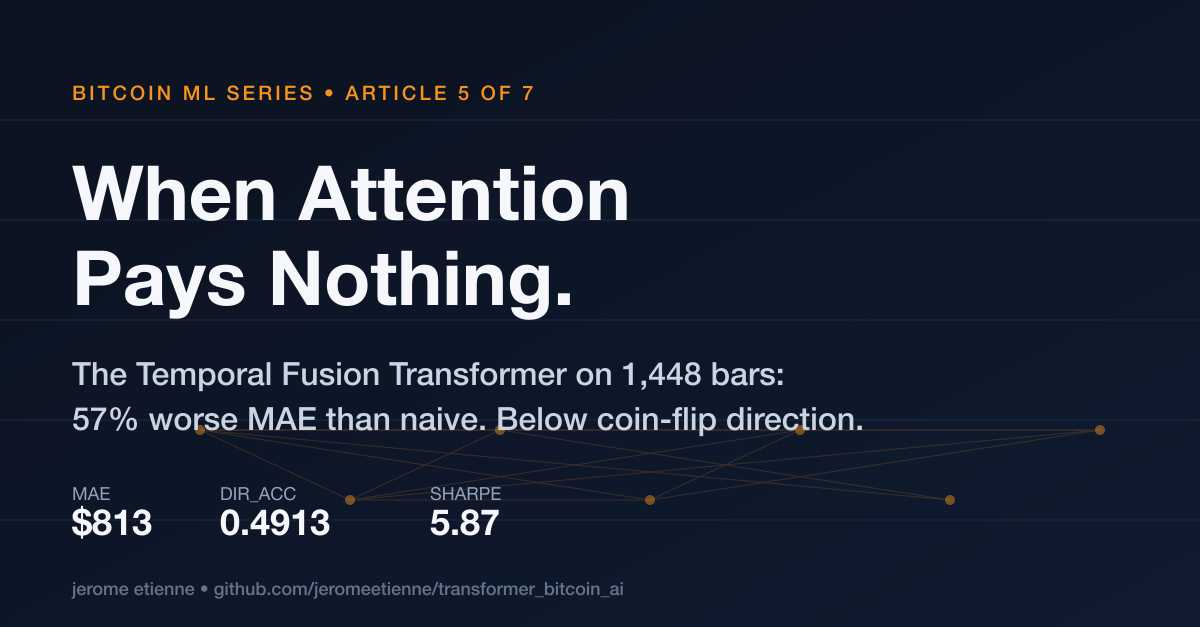
When Attention Fails - The Transformer That Couldn't
by
Jerome Etienne
on
Wed Jun 10 2026
The Temporal Fusion Transformer brings attention, variable selection, and gated residuals to the problem - and posts the worst Sharpe of any trained model. The post argues that on a near-random-walk signal with limited data, architectural sophistication is a liability, not an asset.
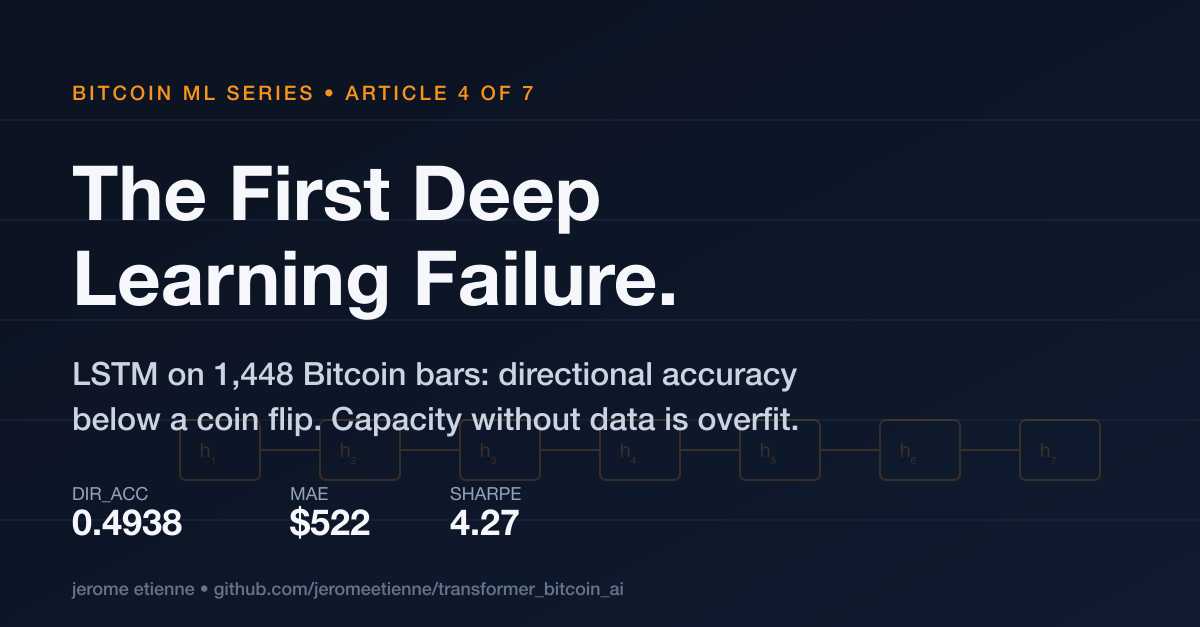
The First Deep Learning Failure - Why LSTMs Lose on This Data
by
Jerome Etienne
on
Mon Jun 08 2026
Two stacked LSTM layers, thousands of parameters, 1,448 training bars - and directional accuracy comes in below a coin flip. The post walks through the architecture, the sweep results (smaller is better), and the structural reason the model fits noise instead of signal.
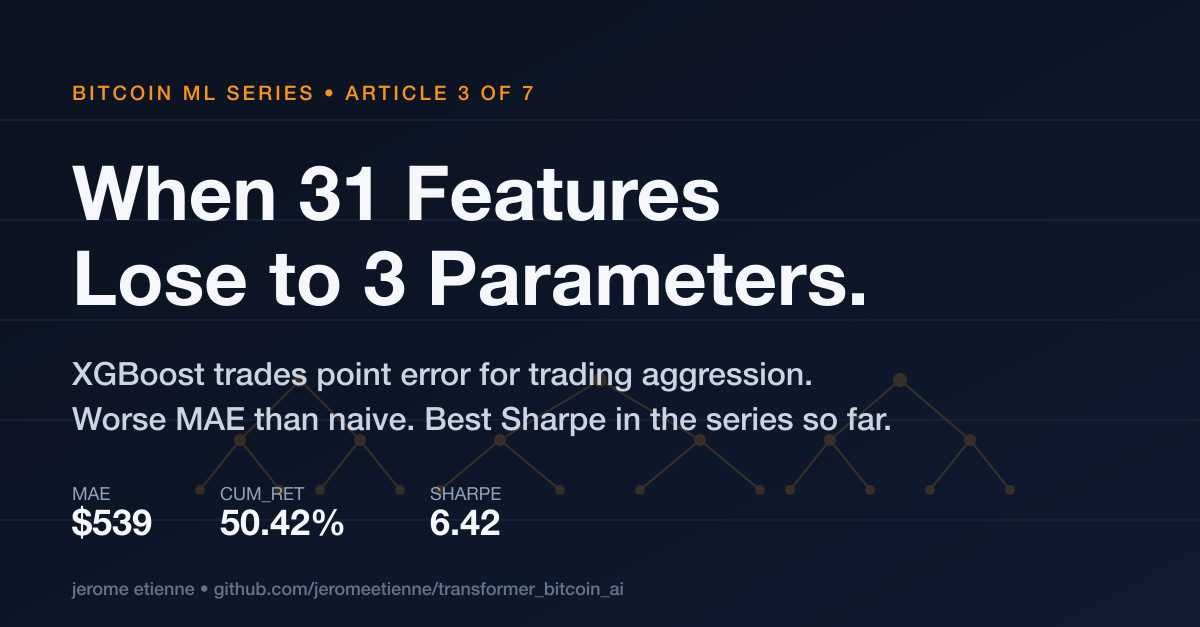
When 31 Features Lose to 3 Parameters - The XGBoost Lesson
by
Jerome Etienne
on
Wed Jun 03 2026
Gradient boosting on 31 engineered features (lagged returns, rolling volatility, OHLC summaries) loses on point error but wins on trading return and Sharpe. A clean illustration that magnitude calibration and directional confidence can beat raw accuracy in a trending regime.
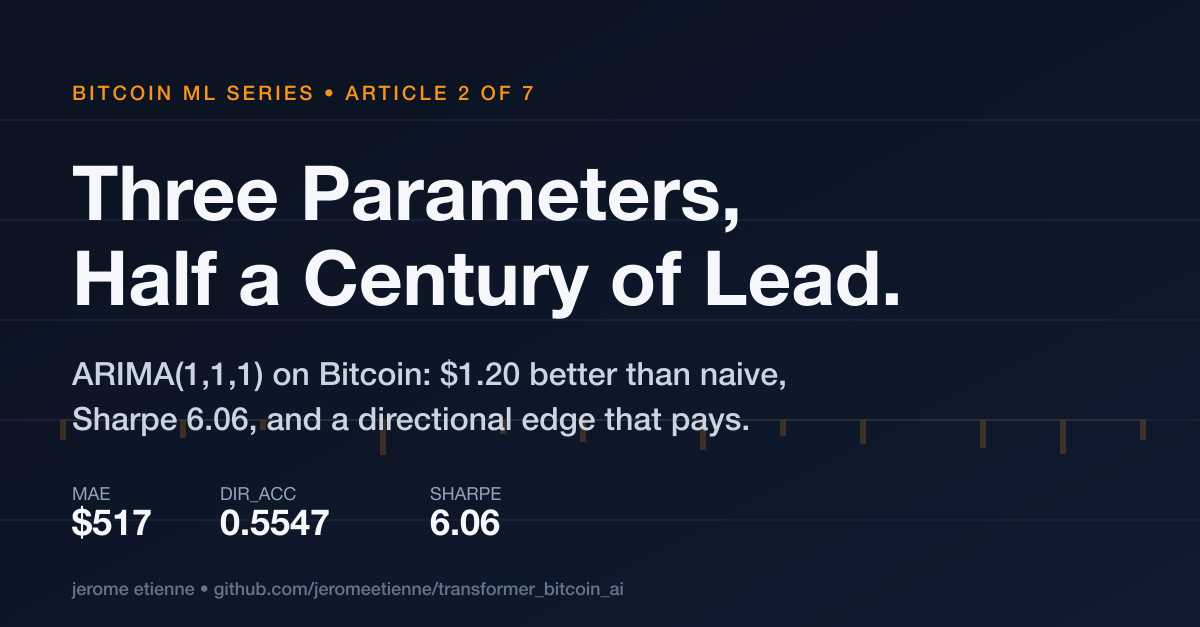
How Classical Statistics Beats the Naive Model (By $1.20)
by
Jerome Etienne
on
Mon Jun 01 2026
ARIMA with three to seven parameters on differenced prices, fit on the same Bitcoin slice. The win on MAE is razor-thin, but the directional accuracy and Sharpe tell a different story - and the order sweep reveals that in-sample selection criteria don't rank out-of-sample trading metrics.
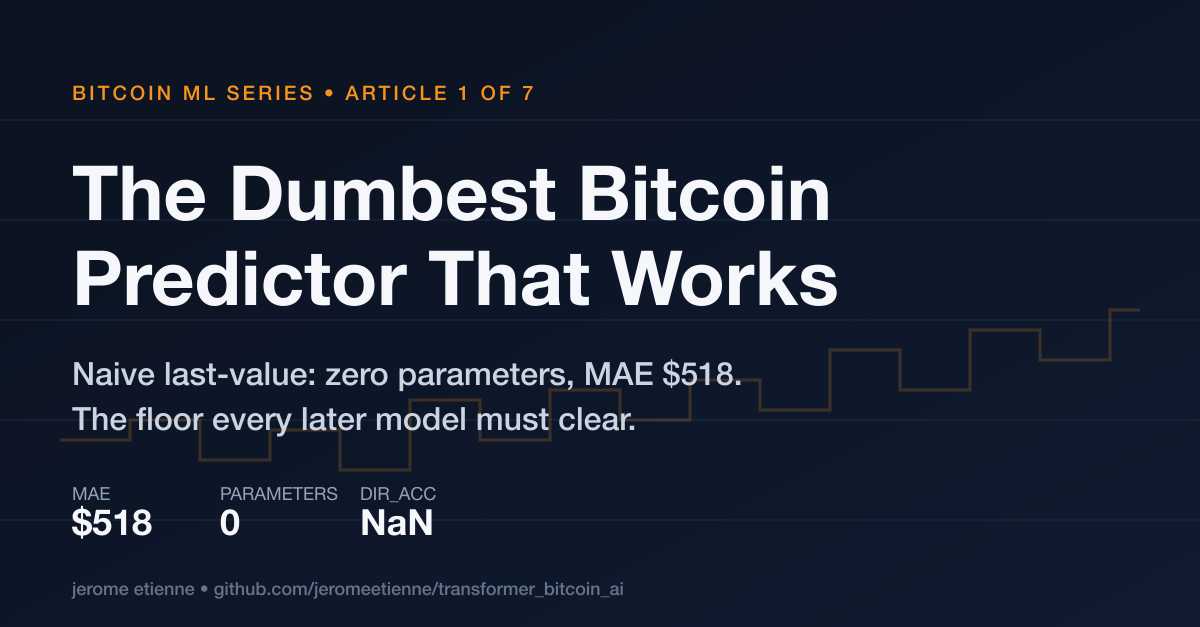
The Dumbest Possible Bitcoin Predictor (And Why It Matters)
by
Jerome Etienne
on
Wed May 27 2026
The naive last-value model - zero parameters, predicts the next bar equals the current bar - sets the floor every later model has to clear. This post explains why a model with no learning is the load-bearing benchmark for the rest of the series.
Can Machine Learning Predict Bitcoin? Seven Models, One Honest Answer
by
Jerome Etienne
on
Mon May 25 2026
Series opener for a 7-model experiment on Bitcoin 4-hour forecasting. Lays out the data, the test window, the metric stack (MAE/RMSE/MAPE/directional accuracy/Sharpe), the evaluation philosophy, and previews the recurring lessons that surface across the ladder from naive baseline to fine-tuned foundation model.
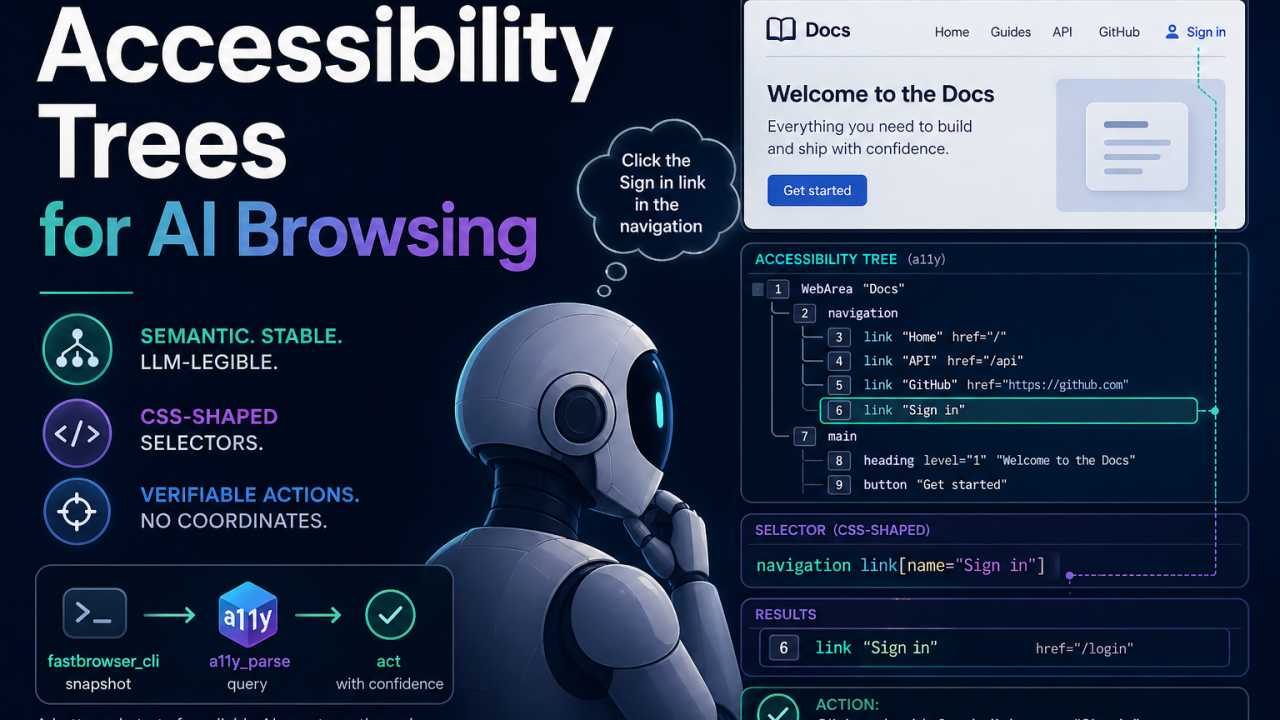
Accessibility Trees for AI Browsing
by
Jerome Etienne
on
Sat May 02 2026
An AI agent looking at a webpage can use raw HTML, a screenshot, or the accessibility tree. This post argues for the third — paired with a CSS-shaped selector language — as the cheapest, most stable, most LLM-legible substrate for agents that browse the web. It covers why the DOM and screenshots fall short, what makes the a11y tree a better default, and how a small CSS-flavored query language over roles, names, and ARIA attributes lets agents point at things without breaking on every redesign.

Reasoning Models, A New Era of Explainable AI
by
Jerome Etienne
on
Sun Feb 09 2025
This post delves into the emerging field of reasoning models in explainable AI (XAI). It highlights how these models, such as Deepseek R1, OpenAI o3, and Google Gemini-2.0, offer inherent transparency by revealing their decision-making processes. This shift from traditional "black box" approaches to models that expose their "chain of thought" promises to enhance trust, accountability, and understanding in AI systems.

Context Switching is Killing Your Productivity - Introducing ContextCast (almost)
by
Jerome Etienne
on
Sun Feb 09 2025
Context switching can severely impact a developer's productivity. This post introduces Fictuous ContextCast, an innovative app designed to mitigate this issue by generating personalized podcasts summarizing your daily work. By leveraging AI to analyze your code, issues, and commits, ContextCast provides an "Audio Overview" to help you seamlessly transition between work sessions, reducing cognitive load and improving efficiency.

How to Build an AI Agent - A Practical Guide
by
Jerome Etienne
on
Sun Feb 09 2025
In this post, I provide a guide to building AI agents. I cover essential components like selecting the right LLM, defining control logic, implementing memory strategies, and equipping agents with tools and APIs. I also offer a step-by-step approach to constructing an AI agent, from choosing the LLM to handling outputs. Additionally, I suggest next steps and resources for continuous learning in AI agent development. Whether you're a beginner or an experienced developer, this guide will help you create effective AI agents.

🎨 The Art of Creation - Parallels Between SoloPreneurs and Hackers
by
Jerome Etienne
on
Mon Feb 03 2025
This post explores the parallels between soloPreneurs and hackers, inspired by Paul Graham's "Hackers and Painters." Both groups thrive on creativity and flexibility. I discuss their similarities, differences, and the unique challenges and opportunities soloPreneurs face today. Join me in examining the art of creation and the future of soloPreneurs in the digital economy.

Exploring User Activation and Product Led Growth ✨
by
Jerome Etienne
on
Tue Jan 28 2025
In this post, I dive into the concept of User Activation, the pivotal moment when users truly understand the value of your product. Discover actionable strategies to enhance onboarding, personalize user experiences, and leverage AI for better engagement. Learn from success stories and join the conversation on effective user activation techniques.

Product Led Growth and Solo-entrepreneur 🚀
by
Jerome Etienne
on
Sat Jan 18 2025
The author explains why product-led growth (PLG) is an ideal strategy for solo-entrepreneurs and how it influenced the design of @contentMagick.ai. They highlight the benefits of PLG and how it aligns with the author's strengths and goals as a solo-entrepreneur. The post emphasizes the importance of building a great product and leveraging its inherent value to drive growth and success.